
Navigating Teenage Executive Functioning and Organization: Insights from a Homeschooled Teen
As parents, navigating the teenage years can often feel like traversing uncharted territory. The shift in priorities, responsibilities, and cognitive development can present unique challenges, especially when it comes to building executive functioning and organizational skills as a teenager. I talked with my teen daughter, Annabelle, to understand her perspective on executive functioning, organization, and planning.
Setting the Stage for Success
Annabelle is a sophomore in high school and began homeschooling in third grade. She acknowledges the challenging transition of learning independently as a teen while also still seeking guidance and support from us as her parents. This important transition time is important for setting the stage for success by establishing a strong, communicative relationship between parents and teenagers.
Evolution of Planning and Organization
As Annabelle has grown she has changed how she prefers to plan and organize her school work From color-coded subjects to embracing paper planners over digital apps. Each student has to find the organization system that works for them, different systems work better for different kids. As parents, it’s important to guide our teens to reflect and understand which techniques or systems are most effective fro them so they can develop their own personalized approach to planning and organization.
Lessons from Adversity: Navigating Academic Challenges
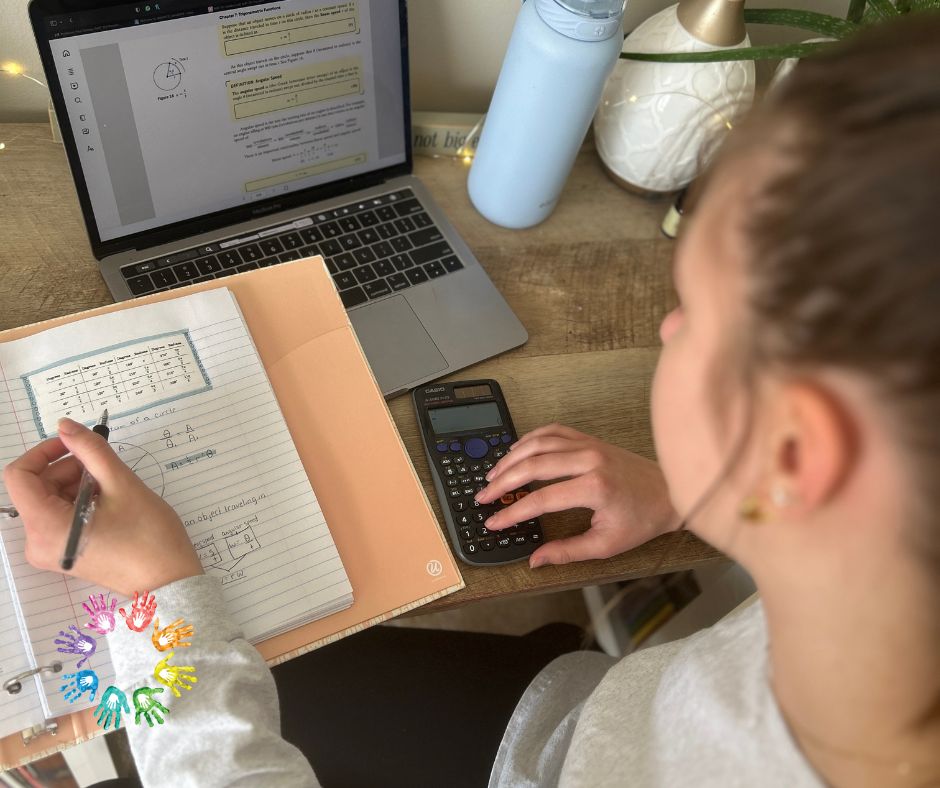
One of the most insightful parts of our conversation was hearing Annabelle’s perspective on her math struggle and how we worked together to overcome it. Through the process, she learned to understand her own learning style and learning preferences. We were able to change her Math curriculum to an online program which was a better fit for her. As parents, understanding the individual learning styles and preferences of our teens can mitigate academic challenges and foster a more effective learning environment.
The Role of a Controlled Environment
As a homeschool student Annabelle has been able create and maintain a controlled environment to optimize her productivity. From setting up reward systems for completing tasks to linking habits with particular spaces, she emphasizes the impact of environmental cues on executive functioning skills. This insight can guide parents in creating conducive environments to support their teens’ organizational efforts.
The Power of Reflection and Adaptation
As I talked with Annabelle I realized how integral the role of reflection is in the development of organizational skills. Our journey underscores the importance of guiding teenagers through the process of reflecting on their experiences to enhance their executive functioning skills. Encouraging open discussions and cultivating a reflective approach can empower teenagers to adapt and refine their organizational methods.
The Significance of Room Organization
Another key aspect of Annabelle’s insights rests in the significance of room organization. She has discovered that a tidy environment leads to improved productivity. Her insight highlights that holistic approaches, including organizing personal spaces, are integral to supporting teenagers in their organizational development and the multifaceted nature of executive functioning.
Empowering Teens through Gradual Release
As parents, it is important to understand the power of gradually releasing responsibilities to our teens. By incrementally empowering teens to take greater control of their organizational endeavors we can encourage our teenagers to take ownership of their organizational methods and ensure that changes in responsibilities do not feel overwhelming to them.
The Promise of Open Communication
Annabelle shares how important the role of open communication between parents and teens is for her as a teenager. It is important to foster a transparent and communicative relationship with our teens, so they feel comfortable expressing their needs and preferences. These conversations can lead to collective understanding allowing for informed decision-making as a family and nurturing our teens’ executive functioning skills.
Navigating the development of executive functioning and organizational skills in teenagers is a dynamic and evolving process. Getting to hear Annabelle’s perspective offers a wealth of insights into the challenges and triumphs that teenagers experience as they navigate this phase of their lives. By embracing gradual release, open communication, and personalized approaches, parents can play an instrumental role in supporting their teens in developing essential executive functioning skills.
OT is IN #12: Executive Functioning in Homeschooling: A Teenager’s Experience with Organization and Planning
In today’s episode, I am joined by a special guest, my daughter, Annabelle Collins, to discuss executive functioning, planning, and organization from her perspective as a homeschooling teenager. She offers insights into her personal experiences, touching on topics such as setting up daily schedules, adapting to different learning systems, managing distractions, and finding motivation. Together, we explore the challenges and successes we have encountered. Join us as we dive into the world of adolescent executive functioning.
In this episode you’ll hear about:
- Setting Up a Homeschooling Day for a Teenager
- A teen perspective on transitioning from traditional schooling to homeschooling
- Adapting to different learning styles
- The impact of independence and supervision
- Implementing strategies to motivate and support learning
- The link between room organization and productivity
- Using Pinterest for room organization ideas
- The importance of habit formation
- Establishing natural consequences for habits
- Parenting Strategies for Executive Functioning Development
- Fostering open communication and a strong parent-child relationship
- Balancing gradual release of control with teenage independence
- The significance of reflection in learning and self-improvement
- Using planning to organize and manage daily tasks
- Prioritizing tasks and setting productive habits
- Encouraging self-reflection and independence in planning
Links and Resources From Today’s Show
- Hatchet Book Guide
- Picture Books that Teach Executive Functioning
- 8 Quick & Easy Questions to Ask Your Homeschool Teen About Their Social Life
- 9 Ways to Build Time Management Skills in Your Homeschool
- What Are Executive Functioning Skills?
- Executive Functioning Focus Group
- Metacognition-Thinking about Thinking
- How to Encourage Note-Taking in Every Stage of Homeschooling
- Smart but Scattered Teens: The “Executive Skills” Program for Helping Teens Reach Their Potential
- Participation Patterns of Adolescents with and without Executive Function Deficits: Parents’ Perspectives
- How to Strengthen Executive Functioning Skills, Sarah on the Raising Lifelong Learners Podcast.
- How to teach your high-schooler organization skills
- 7 Organization Skills To Teach Your Teen


