
How to Encourage Note Taking in Every Stage of Homeschooling
Note taking is a valuable skill that goes beyond just jotting down words on paper. It is a powerful tool that can significantly influence memory, and attention (Smoker et al, 2009). As homeschool parents, we have the wonderful opportunity to guide our children through various stages of note-taking development, helping them become proficient and independent learners.
Let’s explore some strategies to encourage note-taking throughout the different stages of their education.
Early Years – Embrace the Power of Jotting Down:
Even at a young age, children can start to grasp the concept that their words have meaning and can be written down. Whenever your little ones say something meaningful or interesting, take a moment to jot it down on paper together. This simple practice, introduced to me by Julie Bogart in Brave Writer (2019), encourages the connection between spoken and written words, laying the foundation for future note-taking skills.
Elementary Years – Incorporate Narration and Sketching:
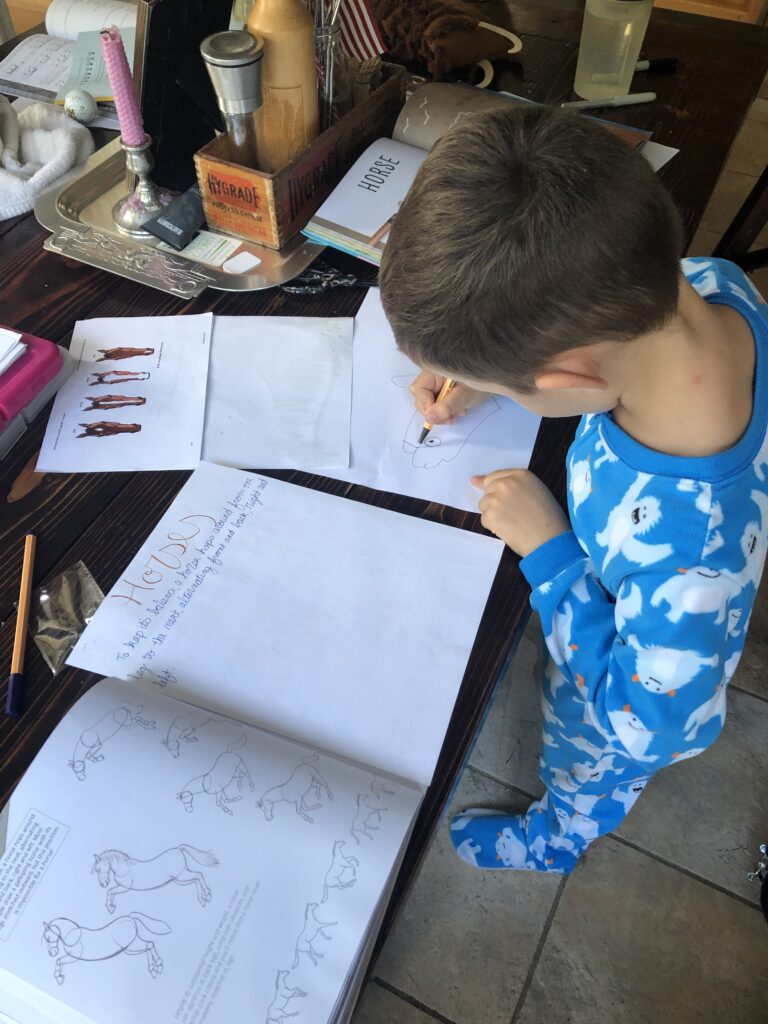
As our children enter the elementary years, they can start using note-taking as a tool to enhance memory and attention. While you read stories or books together encourage them to draw pictures or build with Legos. Then, they can use these to help retell the story. This creative approach to note-taking, inspired by Charlotte Mason, reinforces their understanding of the material, makes it more memorable, and encourages connections across subjects. Afterall, Charlotte Mason says, “education is the science of relations.” (paraphrased)
Later Elementary Years – Introduce Outlining and KWO:
As your children grow older, they can explore more structured note-taking techniques. Introduce them to outlining using the Keyword Outline (KWO) method from the Institute for Excellence in Writing (IEW). With only three words and pictures on a line, this approach helps organize thoughts and enhances their ability to summarize information from source texts.

Early Teen Years – Choose Note-Taking Styles that Suit Individual Learning Styles:
During the early teen years, it becomes essential to adapt note-taking strategies to each child’s learning style. For those who think more linearly, outlining might be a suitable method. Meanwhile, kids with more abstract thinking may benefit from sketch noting, where they draw connections and create visual representations of important concepts. This individualized approach fosters better recall and a deeper understanding of the material.
High School Years – Prepare for Academic Success and Beyond:
As high school approaches, note-taking takes on a more practical dimension, preparing your children for higher education and beyond. Emphasize the importance of noting down key information, definitions, dates, and cause-and-effect relationships. Encourage them to ask critical questions about the material, fostering analytical skills and promoting deeper engagement with the subject matter.
By consistently nurturing note-taking skills throughout your children’s educational journey, you empower them to become lifelong learners. Note-taking is not just about capturing information but about actively engaging with knowledge, making connections, and applying what they have learned in various contexts. Embrace these strategies, adapt them to your children’s unique learning styles, and witness the transformation as they become confident, organized, and successful learners.
Remember, homeschooling offers the flexibility to tailor education to your children’s needs, so enjoy the journey of learning together and watch as they flourish through the power of effective note-taking.
Happy homeschooling!

References
Bogart, J. (2019). The Brave Learner: Finding Everyday Magic in homeschool, learning, and life. Perigee Books.
Mason, C. M., Andreola, D., Macaulay, S. S., Andreola, K., & Thorley, J. (2017). A philosophy of education. Simply Charlotte Mason.
Pudewa, A. (2023, February 28). The power of imitation: Crafting a key word outline. Institute for Excellence in Writing. https://iew.com/help-support/blog/power-imitation-crafting-key-word-outline
Smoker, T. J., Murphy, C. E., & Rockwell, A. K. (2009). Comparing Memory for Handwriting versus Typing. Proceedings of the Human Factors and Ergonomics Society Annual Meeting, 53(22), 1744–1747. https://doi.org/10.1177/154193120905302218