
Nurturing Creativity and Executive Function Through Art in Your Homeschool
In college, my only “C” was in ceramics. My professor told me I wasn’t “one with my clay,” and she was right. I had always struggled with art. In elementary school, I dreaded art class; in high school, I avoided it altogether. My frustration came from not being able to make my projects look the way I pictured them in my mind.
Even later, in occupational therapy school, my connection to art was mostly clinical. We analyzed each project for the motor planning, attention, and executive functioning skills it required, such as sequencing steps, organizing materials, and managing frustration when things didn’t go as planned. Creativity still felt like something outside my comfort zone.
That began to change when we started homeschooling. Art was definitely my weakest area, but learning in community helped me see it differently. As I joined my kids in their art projects, I noticed not only the fine motor and cognitive benefits but also how creating together strengthened their executive function skills like planning, flexible thinking, and problem solving, as well as their social and emotional growth.
This realization came full circle in a recent conversation with artist, homeschool dad, and curriculum creator Ryan Lauterio on The OT is IN podcast. We talked about how art builds creativity, confidence, and the executive functioning foundations our kids need for lifelong learning.
What Does Art Really Teach Our Kids?
Many of us have a narrow view of art—as if it’s a “nice extra,” a purely creative, spontaneous pursuit. Ryan challenged that notion. He sees art as more than the finished painting on the fridge. In his words, art is about gathering, shaping, and refining the raw materials of life (whether clay, words, or even ideas), fashioning them into something that brings about flourishing.
That process? It requires far more than “just” creativity. Our children practice problem-solving, self-monitoring, flexible thinking, emotional regulation, and persistence. Art is, as Ryan says, a “playground for executive functioning skills.”
But What About the Perfectionists… and the Reluctant Artists?
If you’ve ever watched your otherwise joyful child shut down halfway through a drawing, thinking, “It doesn’t look how I wanted,” know that you’re not alone. In fact, I admitted to my guest Ryan that sometimes this is exactly how I feel during my own fifth-grade era art attempts. What he reminded me is that perfectionism in art often isn’t really about getting it “just right.” It’s more about protecting our self-image or avoiding mistakes.
That’s why the shift from “I can’t” to “I can’t do it this way—let’s try another way” matters so much. For more detail on changing this mindset, our workshop, “What to Do When Your Child Says ‘I Can’t’”, is really helpful. Instead of letting a project become a “failure,” you guide your child to ask: “What other way could I try this?” That question itself builds executive functioning skills—planning, flexible thinking, self-monitoring—while transforming art time into a space of growth rather than defeat.
So next time someone says “I can’t,” gently redirect with: “Okay—instead of doing it that way, what if you tried it this other way?” or use declarative language such as “I’m noticing your clenched fists which tell me you are frustrated. I’m wondering if you would feel better if we tried it with XYZ.” Help them brainstorm one new approach, encourage a small step, and celebrate the courage it takes simply to keep creating. Art then becomes not just about the final result, but about development—of motor skills, of cognitive strategies, and of mindset.
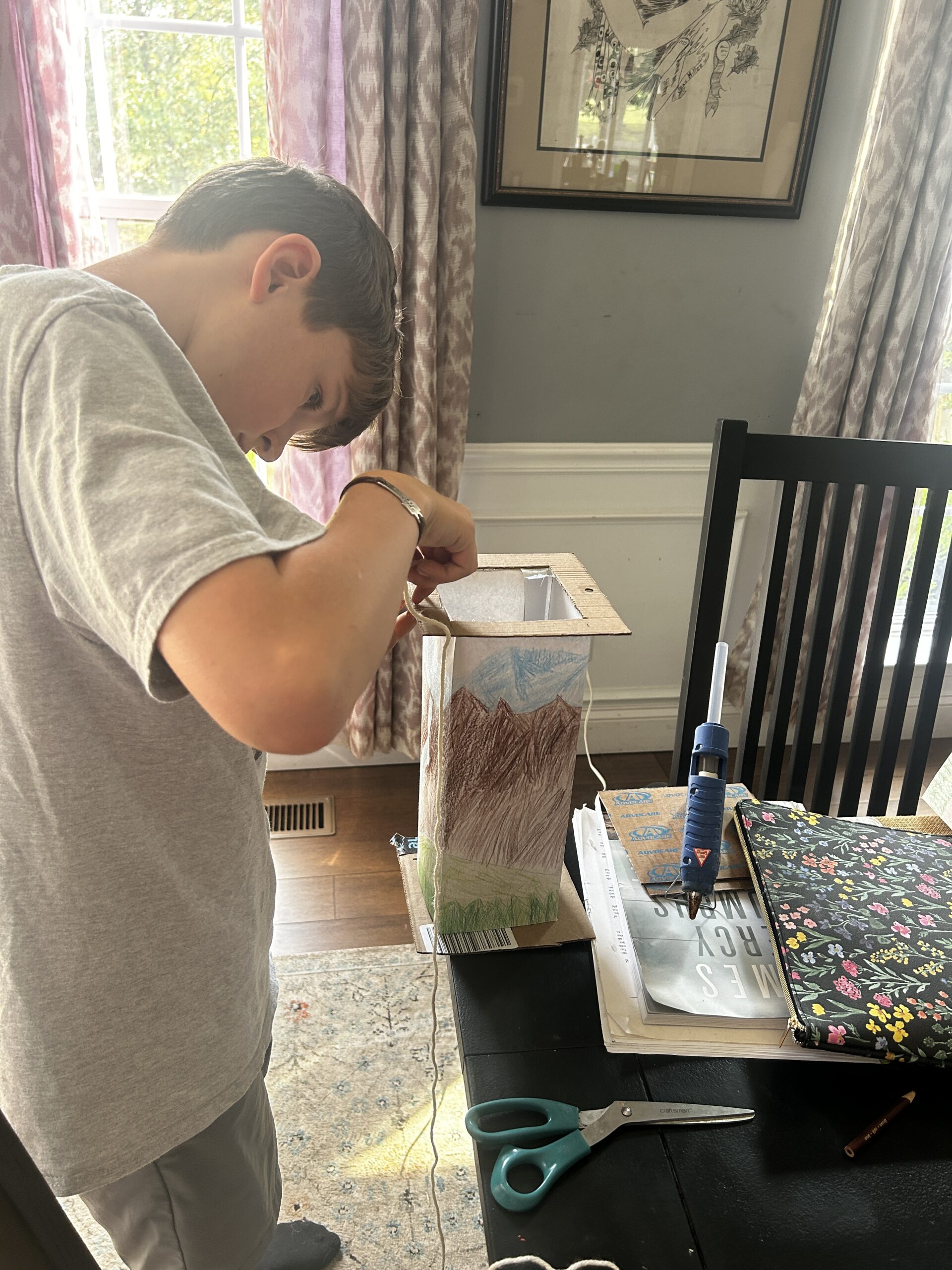
Adapting Art for All Abilities
In our homeschool, art has become a multi-generational endeavor—my son and I tackle lessons together (and yes, sometimes neither of our projects looks like what we imagined). Ryan shared the same experience from years teaching children and college students: progress happens at different rates, but the camaraderie and shared process are invaluable.
Here are some practical ways to adapt art and nurture every child, from the confident to the art cautious:
-
- Spot the Maker in Every Child: Start by noticing where your child is creative. Maybe they bake, tinker with Legos, or love setting up elaborate play scenes. Draw connections between those passions and visual art—the skills overlap.
-
- Break Down the Steps: Offer multiple levels of difficulty for each project. For example, if you’re painting, some children might experiment with brushstrokes on a small canvas, while others complete a larger work over several days.
-
- Celebrate Problem Opportunities: Instead of framing mistakes as failures, treat them as “propertunities” (Ryan’s word!). Each mistake is a chance to learn, adjust, and practice persistence.
-
- Adjust the Environment, Not the Expectation: Let there be mess, a little chaos, and flexibility in scheduling. If your child is lost in a state of flow, sometimes it’s worth pausing the day’s checklist to let them continue.
A Final Word of Encouragement
Perhaps most important, Ryan reminds us that making art is a way for children to encounter themselves as learners, doers, and thinkers—not just human “doings,” but human beings. Our job is to affirm their efforts, show them the why behind our creative work, and then step back enough to let them wrestle, invent, and persist through the messiness.
When you invite your children into art, you’re not just creating a painting. You’re nurturing executive skills, resilience, curiosity—and giving them tools for a lifetime of flourishing.
So, next time the art supplies explode across your table and the project feels endlessly “in progress,” remember: The process is the point. Celebrate the journey—and remember, you’re building far more than artistic skill.

OT is IN #84: Breaking Perfectionism: Encouraging Creative Process and Resilience in Art
I sat down with Ryan, who is a lifelong artist, educator, and founder of faith-based art initiatives, including Shako Art Space, the Maker Institute of Studio Art and Theology, and Made Makers—a K-12 online art curriculum rooted in theology.
Ryan shares his inspiring journey from a childhood shaped by art as a means of self-expression and healing, to leading art education at the country’s top public art school, and ultimately, designing resources to empower homeschoolers and families everywhere. We explore the profound ways that art influences our brains, builds executive functioning skills like persistence and flexibility, and helps us make meaning from the world around us.
We’ll dig into why creativity is inherent in all of us, how to nurture it in children (and ourselves!), and embracing the process over perfection—whether your child is pointing to someone else as “the artist” in the room or discovering their own unique spark through baking, building, or problem-solving. Plus, Ryan offers practical advice and fresh perspectives for parents wanting to cultivate expressive, curious, and resilient learners at home. Get ready to rethink what art means—beyond the paintbrush, beyond the outcome, and into the heart of how we learn, grow, and flourish.
In this episode you’ll hear about:
-
- Brief account of Ryan’s personal and professional background in art
-
- Childhood interest and affirmation in art
-
- Art as a coping mechanism in a difficult family environment
-
- Education (BA, MA, MFA); 17 years teaching at VCU
-
- Founding of Shako Art Space, Maker Institute, and Made Makers (Christian art curriculum)
-
- Ryan’s Perspective on What Art Is
-
- Challenging the narrow definition of art as just expression or creativity
-
- Importance of combining art, design, and craft as interconnected
-
- Art, design, and craft as pervasive in everyday life
-
- Examples: design of household objects, typography, music, architecture
-
- Imagination, Creativity, and the Making Process
-
- Debunking the myth that only some people are creative
-
- Imagination as synthesizing what you know with new possibilities
-
- Creativity as rooted in prior knowledge and context
-
- Everyday examples of imagination in problem-solving (e.g., pouring coffee, driving)
-
- Value of play, risk-taking, and freedom from perfectionism in creative processes
-
- Supporting Children’s Creativity and Executive Functioning
-
- Addressing perfectionism and its root in self-protection rather than the process
-
- The importance of process over product in creative education
-
- Executive functioning skills in art: Flexibility, time management, task initiation, emotional regulation, prior knowledge, impulse control, self-monitoring
-
- Typical reinforcement of perfectionism in schools (praising realism, narrow definitions of creativity)
-
- Broader vision for making and creative knowledge in children
-
- Value of imparting knowledge as a means of growth and blessing for others
-
- Balancing Structure and Flow in Learning
-
- Setting big-picture goals for children’s growth each year
-
- Using larger family and life purposes as reference points to manage structure versus creative flow
-
- Practical Tips for Encouraging Creativity at Home
-
- Broadening the definition of art to uncover creativity in various domains
Looking for and naming creative behavior in non-traditional areas (baking, engineering, sports, fashion)
- Broadening the definition of art to uncover creativity in various domains
-
- The Value of Creativity for Today’s Children
Real-life story: an “at-risk” student flourishes academically through art
- The Value of Creativity for Today’s Children
-
- Art as a serious, knowable subject—not just a freeform activity
-
- The arts as an entry point to learning and self-understanding
-
- Art fostering optimism, encouragement, and persistence
-
- Building intrinsic knowledge, perseverance, and curiosity for lifelong growth
Links and Resources From Today’s Show
Connect With Our Guest, Ryan Lauterio
Ryan is a Christian conservative, multi-award-winning studio artist and educator whose work has been recognized with a Certificate of Special Congressional Recognition for his induction into the Palmdale High School Hall of Fame. Ryan’s professional journey weaves through the dynamic realms of painting, drawing, studio methods, curating, and deeply exploring the intersection of art and theology with over 30 years of experience.
Ryan boasts a substantial academic foundation, earning both a B.A. and an M.A. in Studio Art from CSU Sacramento, followed by an MFA in Painting and Printmaking from Virginia Commonwealth University (VCU). Complementing his extensive art education, Ryan’s theological understanding has been profoundly shaped by three years of rigorous in-house pastoral training at Remnant Church. He served as the Pastor for Art and Culture there from 2014 to 2020, a role that significantly enhanced his ability to weave his faith seamlessly into his artistic pursuits. Ryan is an Associate for Christian Art and Aesthetics at the Cantaro Institute in Niagara Canada.
Ryan has 30 years dedicated to teaching, enriching the lives of his students, and fostering a dynamic learning environment. His comprehensive background and dedication to art education make him a pivotal figure in academic and artistic communities.
Ryan is the founder and Director of Shockoe Artspace in Richmond, VA, an art gallery that has become a hub for local and nationally recognized artists since its inception. Ryan has exhibited his work widely, including the Virginia Museum of Contemporary Art and the Taubman Museum of Art. His artworks, celebrated for their depth and complexity, have been featured in prestigious publications like New American Paintings and Image Journal. They are cherished parts of private and public collections, such as that of Capital One. His written and visual work and insights were recently highlighted in “A Prophet in the Darkness: Exploring Theology in the Art of Georges Rouault,” published as part of IVP’s Studies in Theology and the Arts series