
The Power of Play in Handwriting: Encouragement for Parents Looking Beyond Just Practice
As homeschool parents, we often wear many hats—from teacher and coach to cheerleader and investigator. There’s so much to consider, especially when it comes to teaching foundational skills like handwriting. If you’re imagining a serene scene with your child quietly tracing their letters, absorbed and happy—well, reality tends to paint a different picture: squiggly lines, eraser crumbs, and maybe a little frustration along the way.
Why Play and Imagination Matter More Than Worksheets
Sarah’s journey began in a school setting, where the first sign a child needed OT often showed up through handwriting struggles. The standard approach? More worksheets and more repetition. But, as Sarah noticed, the kids were bored—and honestly, she was bored too.
What changed everything was a simple but powerful shift: connecting letters with imagination and story. Instead of treating handwriting like a box to check, Sarah asked, “What if every letter became a little piece of art? What if each one got to be part of a story?”
The result? A series of handwriting books where uppercase and lowercase letters transform into foxes, dinosaurs, and playful doodles—with children invested and engaged every step of the way.
Meeting Kids Where They Are: Skills Before Letters
Just like handicrafts that require tailoring to different ages and abilities, handwriting needs to be scaffolded, too. Many children actually need to play—and play a lot—with shapes and simple marks before they’re ready for letters. Pre-writing shapes like circles, crosses, and zig-zags are the real building blocks. Sarah described how she designed her books for these early stages to give kids a chance to master foundational skills, not just the finished product.
One of her tips for parents: embrace the process over the perfect product. Celebrate every “jellyfish” that starts as a wobbly circle with proud, creative additions. What matters is the engagement, the confidence-building, and the joy.
Making Handwriting Meaningful—with Flexibility
Kids are motivated by play, Sarah notes, and research affirms it: hundreds of repetitions needed to master a skill can be whittled to just a couple dozen when done through imaginative play. The secret sauce? Making each letter or shape part of a larger, creative context.
Sarah suggests:
- Turn shaping letters into a drawing—let the “F” become a fox with a nose and whiskers.
- Let your child embellish letters with their own ideas—a T-rex eating dinner or a dinosaur signing off their artwork.
- Encourage tracing and side-by-side drawing for children who need a little more support, and let them try independently as confidence grows.
Sarah shared stories of kids “signing” their world with jellyfish after mastering the doodle in her pre-writing book—proof that process trumps product, and learning can actually be delightful.
When Spacing (or Any Skill) Becomes a Roadblock
Many older children can form letters but write them all squished together, making reading their work tough. Rather than endless reminders (“leave a space!”), Sarah’s approach is to give those “spaces” meaning—using themed stories, playful aliens, and visual cues that scaffold the idea until it clicks. Sometimes, learning is as much about seeing differently as it is about practicing.
Encouragement for Parents: Every Scribble Counts
Whether your child is just starting or struggling with the details, remember: skills develop in layered steps, not leaps. Homeschooling gives you the flexibility to prioritize connection, creativity, and play in a way traditional classrooms can’t always manage.
So, if your days look a bit like organized chaos and everyone’s progress is different—that’s okay. The camaraderie, engagement, and individualized approach you cultivate are immensely valuable. Each child’s proud, messy dinosaur or fox-shaped letter is evidence of real growth.
Practical Ideas for Any Age or Stage
Here’s how you can nurture handwriting playfully in your home:
- Start small: Pre-writing shapes matter! Circles, lines, and zigzags are important practice.
- Let doodles “grow” out of letters—a B can become a baby dinosaur, an O can be a bear’s head.
- Allow your child to add creative touches—the more engaged, the more they’ll want to learn.
- Use stories to anchor abstract concepts like spacing or letter formation—turn the line into a landscape or a street for the letters to walk on.
- Celebrate the process, not just the neatness or accuracy.
Above all: trust that play is productive. By making learning enjoyable, you’re not just building handwriting skills—you’re building lifelong confidence, persistence, and creativity.
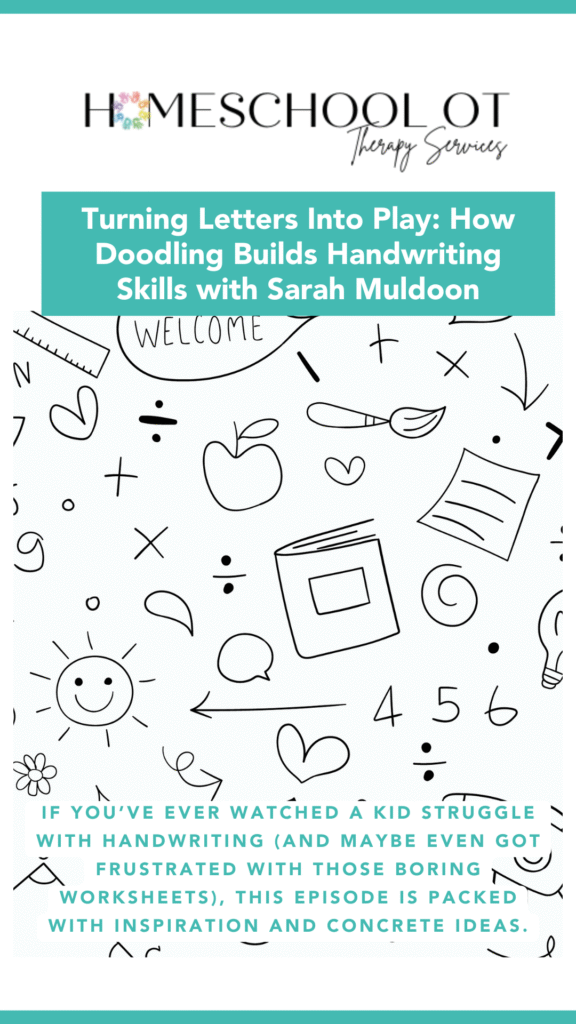
OT is IN #77: Turning Letters Into Play: How Doodling Builds Handwriting Skills with Sarah Muldoon
I am joined by fellow occupational therapist Sarah Muldoon, whose creative, play-based handwriting books are quickly making waves in both the OT and homeschool communities.
Sarah Muldoon shares her journey from working in school systems, where she noticed traditional methods weren’t engaging kids—to self-publishing a series of imaginative, doodle-driven books that help children build core handwriting skills through play and storytelling. They dive deep into the foundational skills behind handwriting, from core strength and visual-motor integration to the magic that happens when kids are having fun and using their imagination.
Whether you’re an OT, a parent, an educator, or part of the growing homeschool world, this episode is packed with insights and practical tips for making learning both functional and fun. Plus, hear about the importance of the “pre-writing” stage, the power of art in literacy, and how Muldoon’s journey led her to national recognition.
In this episode you’ll hear about:
- The motivation for bringing Sarah Muldoon onto the podcast: sharing her products and story with educators and the homeschool community
- Sarah Muldoon’s Occupational Therapy Journey
- Sarah Muldoon’s background as a school-based occupational therapist (OT)
- Challenges with existing handwriting materials: lack of engagement for kids
- The significance of handwriting as a referral point (“canary in the mine”) for OT-related problems
- The OT perspective: the importance of imagination and play in children’s occupations
- Development of Play-Based Handwriting Materials
- The spark for creating imaginative, play-based handwriting books
- Realization of a gap in the market for handwriting materials that link letter formation to creativity and story
- Sarah Muldoon’s process: self-publishing, using graphic design and illustration skills
- Rapid success: from publishing the first book to creating 15 titles, role of social media in her growth
- Understanding Underlying Skills in Handwriting
- Discussion of foundational skills involved in handwriting:
- Core strength, wrist/hand strength, and their importance
- Visual motor integration and oculomotor skills
- The complex interplay of visual scanning, board-to-paper copying, and neurological processes
- OT interventions: warming up muscles, adapting equipment, building visual-motor skills
- Importance of Play in Learning and Skill Acquisition
- Role of play in accelerating skill learning (“400 repetitions vs. 20-30 when play-based”)
- Ways to incorporate play into handwriting practice
- How Sarah Muldoon’s books embed playful, imaginative activities aligned with OT strategies
- Modifying Activities to Support Individual Needs
- How to adapt doodling and handwriting exercises for different children or needs
- Example: breaking down drawing steps, allowing for tracing, providing multiple attempts
- Emphasizing creativity and engagement over perfection
- Defining Play and Its Role in Handwriting
- OT’s definition of play: flow state, imagination, creation, intrinsic enjoyment
- Linking letter formation to storytelling and meaning-making
- How her books foster both skill development and personal expression
- Standardized Assessment in Occupational Therapy
- Introduction to standardized tests like the BOT (Bruininks-Oseretsky Test)
- What OTs are assessing and why: focus on function and “occupation”
- Using tests for pre/post measurements rather than just “teaching to the test”
- Translating test scores into meaningful activities
- Bridging Functional Skills and Playful Practice
- The rationale behind combining assessment-driven skill-building and playful activities
- Examples of how handwriting and drawing practice support broader life skills
- Encouraging continued skill reinforcement throughout daily activities
- Expanding the Reach: Products for Different Ages and Needs
- Overview of Sarah Muldoon’s product line
Links and Resources From Today’s Show
- Why Should I Seek Occupational Therapy?
- Connect with Sarah Collins on IG
- The Homeschool OT Teachers Pay Teachers
- Executive Functioning For Teens Course
- Handwriting Motor Assessment
- Handwriting Course
- Doodles Help Handwriting Website
- Connect With Sarah Muldoon On IG
- Free Doodles
- Improving Handwriting Without Actually Writing
- Skills Nature Builds
- Building Fine Motor skills Using Handicrafts
- Episode 6: Harnessing the Great Outdoors for Visual Development and Learning
- Episode 14: Outdoor Activities to Develop Interoception in Children with Guest Caroline Santangelo
- Episode 22: Supporting Children Through Play-Based Reflex Integration
- Episode 28: Risky Play: Understanding the Benefits and Strategies for Safe Child Development
- Episode 39: Outdoor Adventures: Developing Fine Motor Skills Through Nature-Based Therapy with Carmela Trejo
- Episode 40: Crafting Holiday Memories while Building Handwriting Skills
- Episode 56: Unlocking Writing Confidence in Children: The Role of Personal Expression
Connect With Our Guest, Sarah Muldoon
Sarah is an occupational therapist who has worked with kids as an OT and beyond. She has always been interested in drawing and loved handwriting.