Mindfulness in Homeschooling: Practical Tips from OT Expert Tere Bowen-Irish
Are you a homeschool parent looking for ways to help your children manage anxiety, build attention, and truly enjoy learning? Mindfulness might be the missing piece!
Mindfulness in the Moment: A Toolbox for Every Family
Mindfulness isn’t a fleeting fad or a new-age buzzword, though it feels like it’s everywhere lately. As parents, especially homeschoolers or those supporting diverse learners, we want tools that nurture our children’s focus, self-awareness, and coping skills—but sometimes translating “mindfulness” from theory to family life feels daunting.
Tere Bowen Irish joined us to pull back the curtain on what mindfulness really looks like for real families—and how we can make it approachable for every child (and every parent), no matter their age or ability.
Let’s set the scene.
Imagine a household of siblings or a mixed-age homeschool co-op. Picture the collage of personalities: a five-year-old energetically bouncing, an eight-year-old with a “busy mind,” a pensive twelve-year-old, a parent trying to provide… well, a little calm. No, it’s not a serene yoga retreat. Instead, there’s chatter, a spill of colored pencils, and perhaps the faint clang of a bell—chaos, yes, but the kind where learning is happening.
If your idea of mindfulness is stillness and silence, you might be worried your home can’t “do it right.” You’re not alone! In Tere’s decades of experience with children who sometimes struggle to “fit the mold,” she champions hands-on, adaptable, co-active approaches. Mindfulness doesn’t mean everyone sitting cross-legged with palms up. Instead, it’s about building awareness, presence, and (most importantly) comfort—wherever your family is right now.
What Does Mindfulness Actually Mean for Families?
Mindfulness, as Tere defines it, is simply “an awareness that arises in the present”—paying attention, on purpose, and without judgment. It’s not about emptying your mind. (“Mine never stops buzzing from morning to night!” Tere laughs.) It’s about noticing where your mind goes and gently bringing it back—like a boat drifting on a lake, anchored but still moving with the waves.
When kids (or parents!) feel scattered, focus seems impossible, or anxiety steals the moment, Tere encourages us to start small. Maybe it’s a minute of listening to a bell fade out—or simply noticing the rise and fall of breath with a hand on heart and belly. Maybe it’s inviting your child to look out the window, watch the birds, and share what they feel or see, rather than demanding silence or “attention.”

Meeting Each Child Where They Are: Choice and Comfort
One universal truth? No one size fits all. For true growth—and for trust—kids need to feel safe and comfortable. Tere cautions never to force closed eyes or impose methods that might trigger discomfort or deeper anxieties. Instead, offer options: “Would you like to listen to a story?” “Should we walk quietly together?” “Can you feel your hand rising on your belly when you breathe?” Even lying on the floor is fair game!
This flexibility transforms mindfulness from something done to children into something done with them. When kids know they have agency, they’re more likely to share, explore, and—over time—find what works.
Anchoring Attention, Gently
In a world that demands constant focus, children (and parents) often hear “just pay attention!” but are rarely taught how. Mindfulness bridges that gap. Tere loves simple, playful practices like the “starfish,” tracing and breathing along your fingers; quick one-minute visualization breaks (“Imagine riding down a hill on your bike. Feel the breeze!”); or reflecting on favorite sensory memories—like the Easter egg hunt or building sandcastles.
By routinely returning to these anchor points, children build not only self-regulation, but also a foundation for executive functioning, resilience, and joy. Even kids who once struggled to sleep find comfort tracing starfish breaths under the covers—sometimes wishing for more hands to fall asleep faster!
Predictable Structure, Flexible Mindset
Especially for neurodiverse children or those easily overwhelmed, predictability is key. Mindfulness routines don’t have to be elaborate or inflexible, but creating “containers”—little rituals—helps kids anticipate what’s next and expend less “gas” worrying about transitions. The more these moments are woven into your day, the more readily children will access them in times of stress or distraction.
Tere reminds us that attention, like fuel in a tank, has limits for everyone. We wouldn’t expect a five-year-old (or a forty-year-old!) to remain “on task” for hours. Instead, providing gentle reminders, brief breaks, and permission to wander—and return—is far more effective than shaming lapses.
Encouragement for Parents: Permission to Practice Imperfectly
If you try a mindfulness practice and your living room feels more like organized chaos than Zen, you’re not failing. If your child needs to wiggle, speak up, or see a photo of a manatee to anchor their thoughts, you’re succeeding. You’re showing them that there’s no single “right” way to be aware, present, and calm.
Ultimately, parenting (and homeschooling) is less about mastering quiet and more about modeling presence and curiosity. Ask your child what they imagined while listening to a story. Pause together to notice the sensations around you. Let each member choose—without judgment—the tools that fit best. Mindfulness isn’t a destination. It’s a practice—and a path you can walk together, one moment at a time.
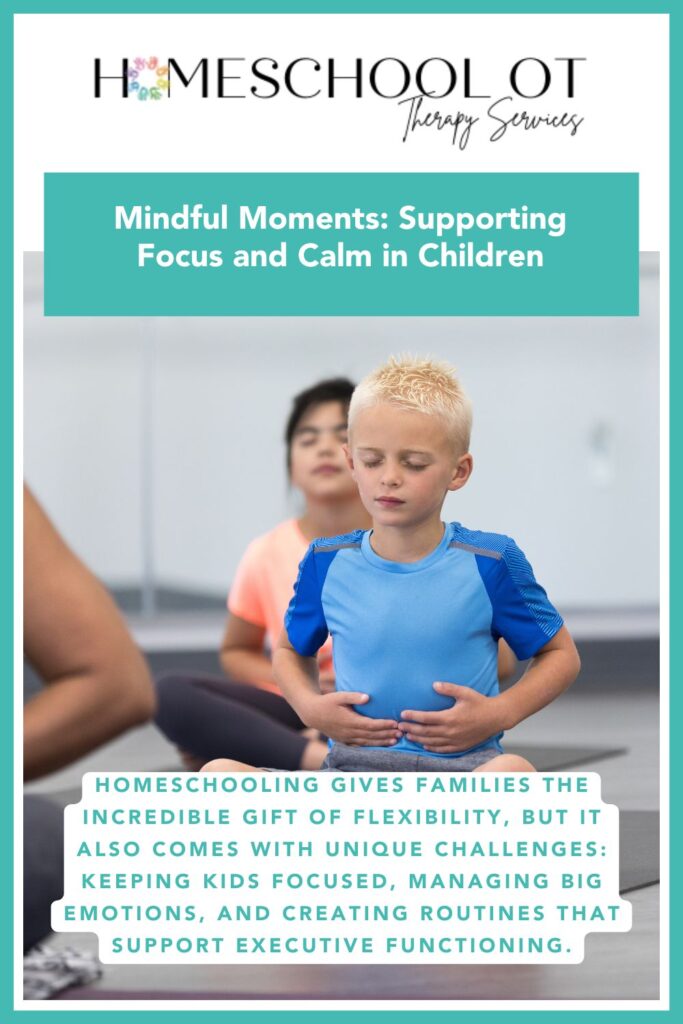
OT is IN #61 Mindful Moments: Supporting Focus and Calm in Children
I’m sitting down with Tere Bowen Irish, an occupational therapist with over 45 years of experience who specializes in mindfulness and yoga, particularly for kids who don’t fit into traditional schooling. Tere’s name kept popping up for her innovative work in blending occupational therapy, mindfulness, and movement—from music and books she’s written to her continuing education efforts for OTs. Today, we’ll unravel the true meaning of mindfulness, moving beyond the buzzword to show how it can help children (and adults!) manage anxiety, build attention skills, and connect more deeply with the present moment.
In this episode you’ll hear about:
- Tere’s Background and Approach
- Tere’s experience as an occupational therapist (45+ years)
- Current work: private practice, teaching mindfulness and yoga to children, especially those struggling in public school settings
- Personal journey into mindfulness through yoga and certification as a kids’ yoga instructor
- Initial curiosity about mindfulness vs. meditation and influences
- Defining Mindfulness
- Reference to Jon Kabat-Zinn’s definition: purposeful awareness in the present moment, without judgment
- Tere’s personal understanding and evolution in practicing mindfulness
- Mindfulness for different ages
- Practical Approaches to Mindfulness for Anxious or Distracted Individuals
- Hands-on, co-active practice recommended
- Addressing perceptions and misconceptions
- Use of metaphors
- Gentle introduction with simple activities like listening to a bell, with options for how children participate
- Emphasis on comfort and emotional safety
- Engaging Children in Mindfulness
- Allowing children to process their experiences and respond naturally
- Using tactile exercises
- Avoiding rigid, prescriptive mindfulness (like mandatory class-wide videos)
- Positive role of interactive apps for teens (e.g., Calm, Ten Percent Happier)
- Visualization activities to engage kids’ senses and focus
- The Role of Senses and Memory in Mindfulness
- Using sensory experiences and recall
- Reference to Charlotte Mason’s educational philosophy
- Discussing the importance of “calling back” attention and deepening sensory engagement
- The Distinction Between Child and Adult Presence
- Illustrative cartoon: child present with surroundings, adult distracted by mental clutter
- Examples from Tere’s personal life
Links and Resources From Today’s Show
- Why Should I Seek Occupational Therapy?
- Connect with Tere on Facebook
- My Mindful Music- Maryann Harman
- Are There Really 3 Types of ADHD?
- Mindfulness and Neural Integration: Daniel Siegel
- Yoga And Me: Come Be A Tree Book
- The Whole Brain Child Book
- Episode 9: The Impact of Music on Executive Functioning: A Homeschooling Perspective
- Episode 10: Streamlining Your Space: Organizing for Better Executive Functioning
- Episode 11: Exploring Unique Learning Paths in Homeschooling with Guest Amy Bodkin
- Episode 12: Executive Functioning in Homeschooling: A Teenager’s Experience with Organization and Planning
- Episode 44: Prioritizing Slow in Homeschooling: A chat with Leslie Martino
Connect with our Guest, Tere Bowen-Irish
Tere Bowen- Irish has practiced Occupational Therapy in pediatrics and psychiatry for over 40 years. Through her business, All the Possibilities, she continues to provide treatment, assessment, and consultation for clients. Workshops for therapists, educators and parents are offered privately, or publicly on a variety of topics such as inclusion, child development, classroom management, behavioral challenges, executive function, and other topics relevant to the 21st century educational system. The focus is on a common sense, practical approach towards empowering educators and students to create a climate of learning, understanding and inclusiveness for all. Tere is also the creator/author of The Drive Thru Menu Suite of Exercises, which is an initiative to bring movement and mindfulness into today’s classrooms. She is a certified YogaKids teacher and a Certified Mindful Schools Instructor. She is the author of Yoga and Me, Come be a Tree and co-authored My Mindful Music with Mary Ann Harman. Feel free to contact Tere at tereirish@gmail.com