

Homeschooling and the PEO Model: Building Foundations Before Curriculum
Many families come to homeschooling because something felt off. Learning may have been stressful, days felt heavy, or your child just did not seem to thrive in traditional educational settings.
When homeschool days feel hard, it is natural to start searching for solutions. A new curriculum, a different schedule, or a program that promises things will finally fall into place.
From an occupational therapy (OT) perspective, this is a very common starting point. It is also where many families get stuck. Real progress in homeschooling doesn’t begin with curriculum. It begins with understanding your child.
The PEO Model-Person, Environment, and Occupation—offers a simple framework parents can use to make better decisions before choosing or changing curriculum.
Core Concept: The PEO Model in Practice
The PEO Model reminds us that learning is not just about what you teach. It’s about how your child experiences learning in their body, their space, and their daily routines.
Person refers to your child.
This includes how their nervous system works, how they regulate emotions, how they process sensory input, and how they approach tasks. Some children need movement before they can think. Some need quiet. Some struggle with getting started or managing frustration. These traits aren’t problems to fix—they are information that helps you support learning more effectively.
Environment is everything around your child while they learn.
This includes noise, lighting, seating, expectations, emotional tone, and even time of day. A child who can think clearly on the couch after movement may shut down at a desk first thing in the morning. The environment can either support regulation or work against it.
Occupation is what fills your child’s day. Reading, writing, chores, play, movement, conversation, and rest all count. When these activities are meaningful and appropriately matched to the child, learning feels possible. When they are mismatched, even the best curriculum can fall apart.
When these three areas work together, learning flows more naturally. When they don’t, parents often see resistance, shutdowns, emotional outbursts, or ongoing power struggles.
Concrete Homeschool Example: Rethinking the Schedule for a Teenager
Consider the family with a teenager who struggled to get started each morning. Initially, the parent worried about motivation and falling behind. However, by applying the PEO lens, they realized the challenge was not “willpower” but physiology. The teen’s nervous system came online later in the day. By rearranging their rhythm, having breakfast together at 9, followed by movement and then independent work after 10 engagement improved dramatically.
This change worked developmentally because it acknowledged the shifting circadian rhythms common during adolescence and respected the teen’s sensory and regulatory needs. The schedule scaffolded engagement rather than demanding compliance with an arbitrary clock. Richer conversations and deeper learning followed once the rhythm fit the person.
Why This Approach Matters: Development, Not Quick Fixes
OT informed homeschooling focuses on growth over time rather than quick fixes. Instead of looking only at results, parents are encouraged to notice patterns throughout the day. Pay attention to when your child seems calm and ready to learn, when challenges show up, and which spaces or routines make learning easier or harder.
This is not about finding a perfect system. It is about making small changes as your child grows and their needs change.
For younger children, this often means having a predictable flow to the day. A simple rhythm like breakfast, a short read aloud, time outside, hands on play, and rest can help children feel secure and ready to engage.
As children grow older, their needs change. Sleep patterns shift, sensory needs develop, and interests deepen. Routines and learning spaces may need to change too. These adjustments are not a sign that something is wrong. They show that parents are responding to their child’s development and supporting learning in a way that fits who their child is becoming.

Start With Your Child Before Making Changes
Effective homeschooling begins by noticing your child before changing curriculum. Instead of searching for new materials right away, pause and observe what is already happening throughout the day.
Notice when your child seems calm and ready to learn and when things begin to feel hard. Pay attention to transitions, energy levels, and what helps your child settle after frustration. These patterns give important clues about when learning is most likely to work.
Before adjusting lessons, look at the environment. Ask yourself whether your child needs movement, flexibility, or quiet in order to stay engaged. Sometimes learning works better on the couch than at the table or after outdoor play rather than first thing in the morning.
Routines matter more than the clock. Learning often flows more easily when it is anchored to natural parts of the day like after breakfast, after movement, or before lunch.
Interests also matter. Notice what your child chooses during free time, what they talk about often, and what they return to again and again. These interests are not distractions. They are powerful entry points for learning.
A Simple Observation Guide
Use these questions to guide small changes before switching curriculum.
When is my child most calm and ready to learn?
When do transitions feel hardest?
What helps my child reset after frustration?
Does my child focus better sitting, standing, or moving?
Would a quieter or more flexible space help?
What times of day feel easiest?
What times tend to fall apart?
Can learning be tied to meals, outdoor time, or rest?
What activities does my child return to willingly?
What topics hold their attention?
What do they persist with even when it is challenging?
Choose one area to focus on this week. Small shifts in environment, routine, or expectations often lead to meaningful changes in engagement and regulation without changing curriculum.
PS. Try out the companion guide and talk it out with other parents because homeschooling is NOT alone schooling.
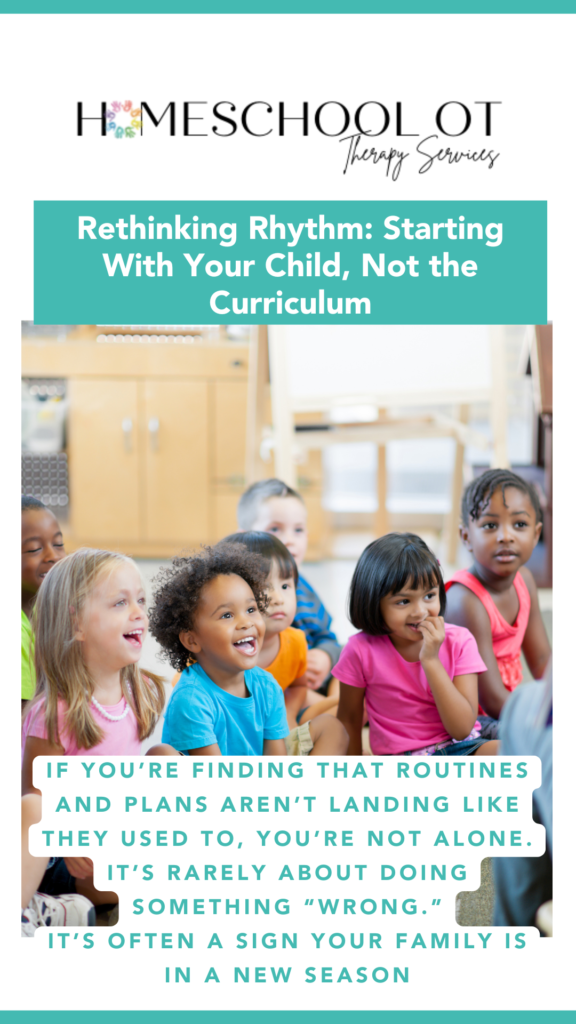
OT is IN #87: Rethinking Rhythm: Starting With Your Child, Not the Curriculum
If your homeschool days seem to run smoothly one season and unravel the next, this episode will help you understand why. Today we’re exploring how the rhythm of your day shifts as your children grow and why what worked before may suddenly feel impossible. In homeschooling, these changes aren’t problems to fix, but transitions to understand.
I’ll walk you through how I observe children’s patterns and needs using a practical framework: the PEO model—person, environment, and occupation. You’ll learn why starting with curriculum often misses the mark, and how putting your child’s individuality, regulation, and interests at the center creates learning that actually sticks.
This matters because in a homeschool setting, you have the flexibility to shape both space and schedule to fit where your child is developmentally. Recognizing these shifts gives you clearer options, replaces urgency with confidence, and helps you build days that support connection before curriculum, especially for kids who didn’t fit in traditional environments.
In this episode you’ll hear about:
- Understanding Changes in Homeschool Rhythm
- Recognizing developmental shifts versus problems to fix
- Concept of “Connection over Curriculum”
- Managing Urgency and Educational Decisions
- Stress around leaving traditional school or seeking a fresh homeschool start
- The tendency to rush into curriculum choices
- The Foundation: Start with the Child, Not the Curriculum
- Education works best when child-centered, not curriculum-centered
- Introduction to the PEO Model (Person, Environment, Occupation)
- Two key truths: Parents know and love their child best
- Scriptural reference: Ephesians 2:10—children as unique and purposeful
- Reference to Charlotte Mason’s educational philosophy—children as “born persons”
- Definition of acceptance (seeing the child without comparison or urgency)
- Definition of expectancy (believing in meaningful and supported growth)
- Importance of holding both acceptance and expectancy together
- Observing and Understanding Your Child (The OT Lens)
- Observational strategies for understanding “the person” in the PEO model
- Noticing regulation and sensory needs
- Noticing the role of joy and interests as “doorways” into learning
- Shifting Away From “What’s Wrong” to “What’s Needed”
- Changing focus from problems to supports needed for a child to thrive
- Prioritizing connection and emotional safety before curriculum
- The Neuroscience Behind Connection and Learning
- Introduction to Stephen Porges and Polyvagal Theory
- Environment: Designing Supportive Spaces and Rhythms
- Adapting Rhythms as Children Grow
- Practical Examples of Supporting Regulation and Rhythm
- Story of a preschooler whose meltdowns improved with a more predictable daily flow
- Story of a teenager whose engagement improved by shifting his schedule later in the day
- Environmental Reflections for Listeners
- Inviting listeners to evaluate and make simple changes to their physical spaces and daily anchors
- Using Interests to Drive Learning
- Identifying interests via observation in free time and conversation
- Practical examples of adapting curriculum and learning activities to interests and needs (movement, chunking tasks, choice)
Links and Resources From Today’s Show
- Download The Companion Guide For Acceptance & Expectancy In Homeschooling
- Why Should I Seek Occupational Therapy?
- Connect with Sarah Collins on IG
- The Homeschool OT Teachers Pay Teachers
- Homeschool Daily Setup: Parental Planning Guide
- Polyvagal Theory: A Science of Safety
- Systematic Review of School-Wide Trauma-Informed Approaches
- Check Out Our Title Sponsor Lovevery
- Learning RX Website
- Episode 4: The Evolving Landscape of Homeschool Community Support
- Episode 11: Exploring Unique Learning Paths in Homeschooling with Guest Amy Bodkin
- Episode 17: Neuro Affirming Homeschool Environments with Keisha Berry
- Episode 18: Practical Sleep Solutions for Children: Insights from Occupational Therapy
- Episode 28: Risky Play: Understanding the Benefits and Strategies for Safe Child Development
- Episode 35: Connecting Speech, Phonemic Awareness, and Literacy: Sydney B. Explains it All
- Episode 48: Transforming Fashion for Sensory Needs: An Interview with Julia, Adaptive Apparel Pioneer
- Episode 50: Ask The OT, A Special 50th Episode
Thank you to our title sponsor for this episode, Lovevery. You can check out their products and resources here.


