Supporting Handwriting Development, Legibility and Growth
Homeschooling invites us to look beyond what our children produce and begin to understand how they learn. This becomes especially clear with handwriting. Many homeschool parents find themselves asking the same questions: Why is my child’s handwriting messy? Do we need to focus on neatness? Does handwriting still matter in a world of typing and technology? And most importantly, how do we support progress without turning writing into a daily frustration?
Why Handwriting Matters: OT and Brain Research
In this episode, I sat down with Polly Benson, an occupational therapist who specializes in handwriting and motor development, to talk through what actually matters when it comes to writing.
Research shows that writing by hand activates the brain differently than typing. When children write and think about what they are writing at the same time, they retain more information and understand it more deeply.
This happens because handwriting requires multiple systems to work together:
visual processing
motor planning
sensory feedback
eye hand coordination
In occupational therapy, we look at how these systems integrate. When a child is physically forming letters, the brain receives feedback from movement, touch, and vision all at once. That layered input strengthens learning in a way typing simply does not.
Typing can be helpful for access, but it does not replace the developmental benefits of handwriting.
Defining Good Handwriting: Legibility Over Perfection
Many homeschool parents feel pressure to get handwriting “neat” right away. It makes sense. We want our children to do things well.
But as Polly Benson shared in this conversation, perfection is not the goal. Legibility is.
In occupational therapy, we are not asking, “Does this look beautiful?”
We are asking, “Can this be easily read?”
That shift changes everything.
When we look at handwriting through a functional lens, we focus on what actually matters:
- Can your child distinguish between tall and small letters?
- Are letters fully formed and closed when needed?
- Is there clear spacing between words?
- Does the writing stay on the line?
If those pieces are in place, handwriting is doing its job.
Instead of pushing for perfect writing, we begin to scaffold toward clear and consistent output. That might mean slowing down, reducing how much your child writes, or focusing on just one component at a time.
Progress in handwriting does not come from higher expectations alone.
It comes from supporting the specific skills that are missing underneath.
Addressing Perfectionism and Resistance
When a child resists handwriting or shuts down, it is easy to assume it is a behavior issue.
Most of the time, it is not.
As we talked about in this episode, handwriting asks children to manage a lot all at once. They are holding the pencil, stabilizing their body, organizing their thoughts, forming letters, and remembering what they want to say.
That is a heavy cognitive and motor load.
When that load gets too high, children will often avoid, rush, or become overly focused on getting everything “just right.”
Reduce the Load First
Before asking for more effort, we want to make the task more manageable.
You can do this by:
- letting your child say their ideas out loud before writing
- having them copy instead of generating original sentences
- shortening the amount they need to write
- focusing on one skill at a time, such as spacing or letter size
In occupational therapy, we call this grading the task.
We adjust the demand so the child can be successful while still building skill.
Make It Functional and Relevant
Handwriting improves faster when it has a purpose.
Instead of adding more worksheets, try:
- writing a grocery list together
- labeling a drawing
- making a short scavenger hunt
- writing instructions for a game or activity
When writing connects to real life, resistance often decreases.
For the Child Who Feels Stuck or Anxious
Some children need to slow the process down before they can move forward.
Simple, playful activities can help:
- drawing or writing along a curved or wavy line
- tracing paths with a small object like a car or magnet
- writing in a different position, such as on a wall or whiteboard
These types of activities support attention, regulation, and motor control without adding pressure.
A Helpful Reframe
If your child is resisting handwriting, it is worth asking:
Is this a motivation problem
or a capacity problem?
When we shift from pushing for neatness to supporting engagement, legibility, and real life function, children are more likely to participate and improve.
Parent Mindset: Acceptance and Expectation
One of the most important shifts in supporting handwriting is not a strategy. It is mindset.
An occupational therapy approach asks us to hold two things at the same time.
We accept what is hard for a child right now, while also building realistic expectations for growth over time.
Challenges are not meant to be ignored.
They are not meant to be pushed through without support either.
They are meant to be understood.
When we understand what is making handwriting difficult, we can respond with clarity, patience, and a plan that matches our child’s development.
OT is IN #92: Beyond Perfection: How to Foster Legible and Functional Handwriting
If you’ve found yourself wondering if handwriting still matters in a digital world, or why your child’s writing looks so different from their abilities in other areas, this episode is for you. We are unpacking the real value of handwriting for learning—both print and cursive—and why these skills deserve attention in a homeschool setting. You’ll hear practical insights about what “good handwriting” actually means, how to spot the foundational skills your child needs before writing even begins, and how environment and mindset have more influence than any fine motor activity alone.
In this episode you’ll hear about:
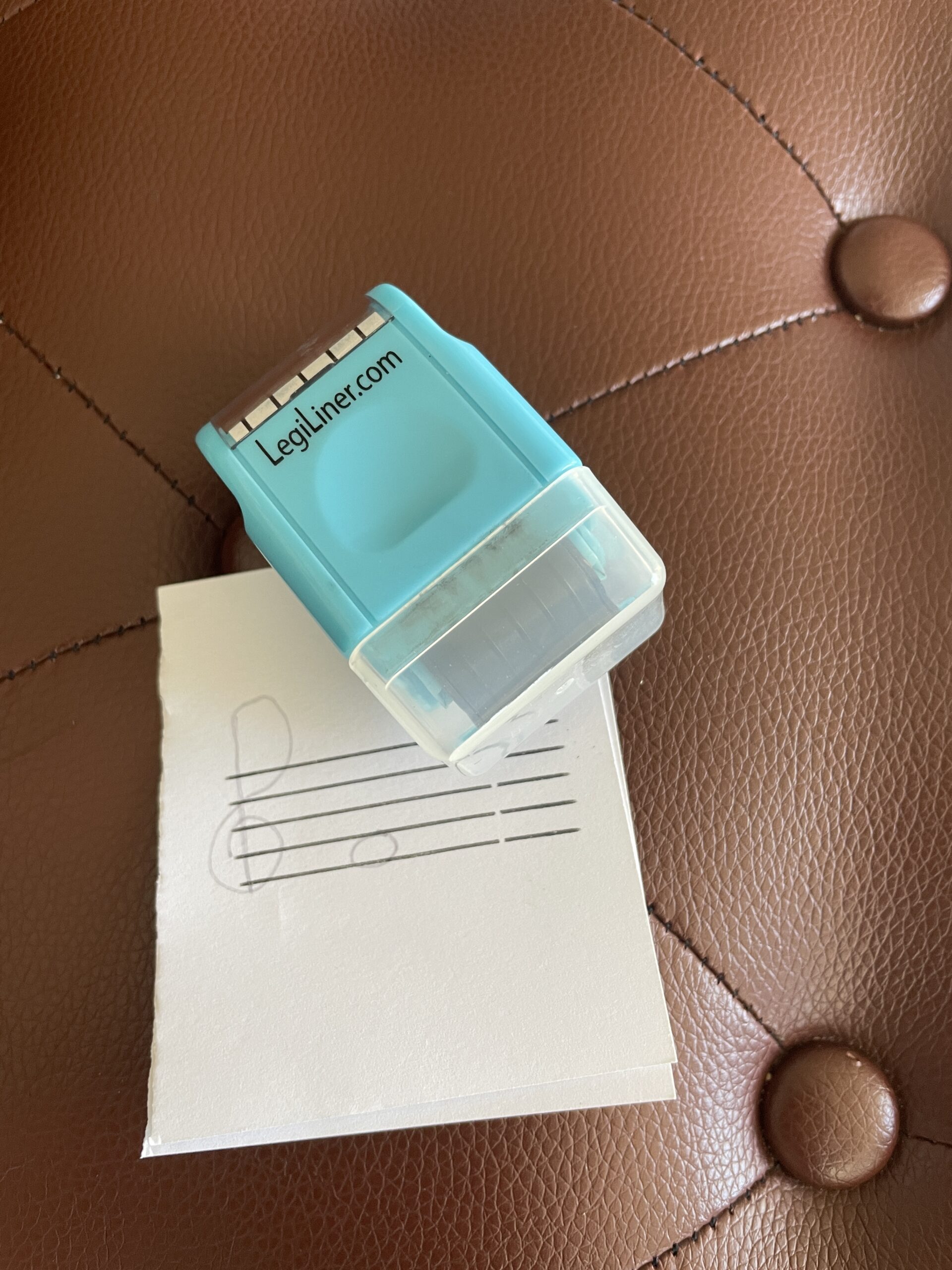
- Handwriting coaching and creation of Ledgie Liner stamps
- Observations from pushing into classrooms (lack of handwriting guidelines in older grades)
- Inspiration and development of a rolling ink stamp for handwriting
- Teacher and student responses, patenting the product, and building a business
- The Importance of Handwriting in a Digital Age
- Brain connections and retention linked to handwriting
- Fine motor and sensory benefits of writing versus typing
- The value of handwriting for reading fluency and cognitive development
- The renewed push to teach cursive
- Defining “Good” Handwriting
- Primary importance of legibility over perfection or pencil grip
- Analyzing what makes handwriting legible
- Letter height (e.g., differentiating N vs. H)
- Letter closure (e.g., A vs. U)
- Spacing and orientation on the line
- Importance of pinpointing specific issues to focus on for improvement
- Techniques and Strategies for Teaching Handwriting
- Using lines and cues to support handwriting:
- Teaching with tall, small, and “fall” letters
- Employing creative analogies (sky/grass/ground, fish for underwater letters)
- Customizing strategies to student interests and developmental level
- The benefits of the homeschool environment for flexibility and customization
- Foundational Skills and Environmental Factors
- Handwriting Versus Perfectionism
- Differentiating functional handwriting from perfection/neatness
- Emphasis on legibility and function over picture-perfect writing
Links and Resources From Today’s Show
- Why Should I Seek Occupational Therapy?
- Connect with Sarah Collins on IG
- The Homeschool OT Teachers Pay Teachers
- LegiLiner Website
- Polly Benson LinkedIn
- Polly Benson Instagram
- LegiLiner Youtube
- LegiLiner Amazon
- Check Out Our Title Sponsor CTC Math
- CTC Math Free Trial
- Primitive Reflexes Resource Guide
- How To Think About Handwriting
- Making Sense Of The Handwriting Puzzle- Course
- Episode 8: Beyond the Pencil: Exploring Vision’s Impact on Homeschool Handwriting Success
- Episode 23: Blending Sensory Integration and Fitness for Better Handwriting
- Episode 38: Practical Learning Tools from a Homeschool Graduate: Sensory Kits for Homeschool Success
- Episode 55: Understanding Dysgraphia: Tools and Strategies for Homeschoolers
- Episode 56: Unlocking Writing Confidence in Children: The Role of Personal Expression
- Episode 77: Turning letters into play- how doodling helps handwriting
Thank you to our title sponsor for this episode, CTC Math. You can check out their FREE trial here.
Connect With Our Guest, Polly Benson
Polly Benson, OTR/L, also known as The OT Handwriting Coach, is a seasoned occupational therapist with over 30 years of experience helping children build confidence through improved handwriting and fine motor skills. She’s the inventor of LegiLiner®, a popular rolling ink stamp used by thousands of educators and therapists to make handwriting practice easy and effective. Polly is passionate about making OT strategies accessible—especially for students who don’t qualify for services but still need support.
In addition to presenting nationally, Polly mentors other OT entrepreneurs and launched a mastermind networking group to help therapists and teachers grow product-based businesses that make a difference. Her company donates 10% of profits to support the special needs community, extending her mission of impact beyond the classroom. Polly will also be featured this year on “Legacy Makers” showing on Inside Success TV, celebrating her work in innovation, education, and advocacy. With a heart for service and a gift for making learning fun, Polly is on a mission to help every child write with confidence.