

When the Diagnosis Isn’t the Destination: Encouragement for Parents Navigating Neurodiversity
Homeschooling, parenting, and supporting kids who work a little harder to learn is not a journey marked by calm rooms, quiet voices, or picture-perfect plans. If you’re envisioning tidy schedules, neat handwriting, and children moving seamlessly from math drills to history read-alouds, you’re likely not picturing the reality of my home—or yours! Our days, especially when neurodiversity is part of the equation, often look and feel more like organized chaos.
Diagnosis as a Starting Point, Not a Finish Line
Gretchen’s words echoed a truth many of us know in our bones: “A diagnosis is not a destination. It’s just a place on the path where you now have more information.” Knowing this can lift a huge weight off the shoulders of parents who feel pressure to have everything figured out the moment a label enters the room. Whether you seek out a formal diagnosis or simply adjust to your child’s needs based on observation and instinct, the most important question becomes—what will you do with this new knowledge?
Some days, that knowledge opens doors. Gretchen shared how, for one child, accommodations like extended test time made a tangible difference—doors to college, confidence, and opportunities swung open. Other days, a diagnosis may only give you a starting point for conversations at home: “Your brain thinks differently. That’s not just okay—it’s powerful.” The challenge, and gift, is meeting your child where they are with honesty, affirmation, and tangible support.
Sharing the Journey—Not Just the Answers
Our conversation circled around the importance of speaking openly and age-appropriately with our kids about who they are and how they learn. Whether your child is seven and noticing reading feels impossible, or seventeen and anxious about a new job or college class, what matters most is collaboration, not limitation.
We both learned—sometimes through trial, error, and later-born wisdom—to frame differences as opportunities, not deficits. Tell your child, “I notice you’re working so hard at this,” or, “Let’s figure this out together.” Give room for “I can’t do it YET,” and teach them to ask for help, modeling that vulnerability with your own struggles (“Looks like I can’t figure this out—can you help me brainstorm another way?”).
Building a Network of Support and Skills
Perhaps the greatest encouragement Gretchen offered was the value of nurturing not just academic skills, but real-world, relational ones. Self-advocacy, making doctor’s appointments, seeking feedback, and asking, “Can you help me understand?”—these are the seeds we plant at the kitchen table that grow into confident, adaptable adults.
Don’t be afraid to involve other caring adults—co-op leaders, coaches, church mentors—in your child’s growth. Sometimes, it’s the outside voices affirming your child’s strengths that light a new path for them.

It’s Not About Being Perfect—It’s About Being Present
If you’re feeling overwhelmed, consider this: Every parent is learning alongside their child. Sometimes the youngest gets a more experienced version of you than the oldest did. Sometimes we have to go back, apologize, or modify what’s not working. Our greatest gift to our kids is not perfection, but presence—being there to reflect, to ask questions, to admit mistakes, and to keep moving forward together.
Let’s remember: Our goal isn’t to shield our children from every hard thing, but to teach them to navigate those challenges with the confidence to ask for help and the awareness to say, “I need a new strategy.” The beauty of neurodiversity—of any difference—is that it calls us deeper into empathy, creativity, and connection as families.
So if today feels messy, remember: Mess doesn’t mean failure. Sometimes, it means you’re exactly where you need to be—side by side, learning, adapting, and growing stronger together.
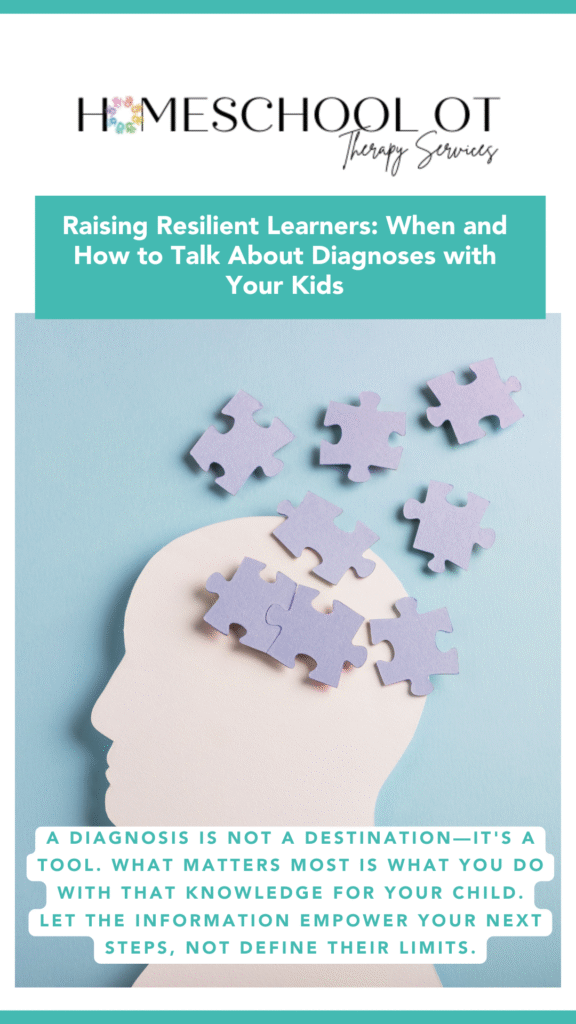
OT is IN #71: Raising Resilient Learners: When and How to Talk About Diagnoses with Your Kids
I am joined by Gretchen Roe for a heartfelt and insightful conversation about navigating learning challenges with neurodivergent kids. Gretchen shares her personal journeys through homeschooling, discussing everything from the decision to seek formal diagnoses for her children to the ups and downs of finding the right support and resources.
Together, we explore how to talk with kids about learning differences in a positive, empowering way, the importance of fostering self-advocacy skills, and the crucial role that other caring adults and community play in supporting children as they grow. With stories from our own families, practical advice, and plenty of warmth and humor, this episode is a must-listen for any parent, educator, or caregiver seeking a path forward when learning feels hard.
In this episode you’ll hear about:
- Gretchen’s background
- The Process and Value of Diagnosis
- Gretchen’s view that diagnosis is not a destination, but just a point on the path.
- Questions about whether and how to share a diagnosis with children.
- Avoiding limiting language tied to a diagnosis.
- Seeking Diagnosis: Personal Experiences
- Gretchen’s experience seeking a formal diagnosis for her son with acute dyslexia.
- Comparison with Sarah’s experience using public school evaluation:
- Deciding on Diagnosis and Accommodations
- Reflecting on reasons for pursuing diagnosis (information, resources, labels, fear of stigma).
- Discussion of accommodations for standardized testing (SAT/ACT) and the need for an established paper trail.
- Timing and consequences of seeking/not seeking accommodations.
- Talking to Kids About Their Diagnosis and Learning Differences
- When and how to initiate conversations with children.
- Changing “I can’t” statements into productive collaboration.
- Encouraging children to ask for help and reframe challenges.
- Parenting Strategies for Navigating Neurodiversity
- Teaching children to seek help productively.
- Modeling adaptive behaviors and self-awareness as parents.
- Handling setbacks and being open about parental mistakes and learning together.
- Preparing Neurodivergent Teens for Independence and Adulthood
- Teaching practical life and self-advocacy skills.
- Encouraging mentorship and guidance from other adults besides parents.
- Empowering teens to seek feedback about their strengths.
- Supporting Teens’ Transition to Work or College
Links and Resources From Today’s Show
- Why Should I Seek Occupational Therapy?
- Connect with Sarah Collins on IG
- Games That Teach Executive Function
- Executive Functioning For Teens Course
- Demme Learning
- What Are Executive Function Skills?
- Field Trips Can Build Executive Functioning
- Episode 2: Decoding Behavior in homeschooling- sensory overwhelm, emotional control, perseverance
- Episode 43: Collaborative Problem-Solving in Education and Parenting
- Episode 60: Tackling Childhood Anxiety: How Occupational Therapy Can Help
- Episode 66: Shifting From Compliance to Connection: The Power of Declarative Language in Supporting Kids
Connect With Our Guest, Gretchen Roe
Gretchen Roe has 21 years of home education experience with her six children, all of whom have now graduated. With a degree in psychology and child development, she has spent the last 27 years in positions of homeschool advocacy, developing special bonds with families of children who work harder to learn. With Demme Learning since 2014, first as a Special Needs Placement Specialist, now serving as the company’s Community Outreach Coordinator, she loves the outdoors, all things furry, chicken raising, and beekeeping. She is a high school swim coach and a second-degree Taekwondo Black Belt.


