
The Power of Music in the Home: Encouragement for Parents Blending Learning, Play, and Regulation
Music slips into almost every corner of family life. It can be the background to a pre-breakfast dance party, a quiet moment after a long day, the glue holding together car rides and memories alike. But can music be more than entertainment in our home environment, especially when we’re teaching and parenting children of different ages and interests?
Music for All Ages, Interests, and Abilities
Picture a home filled with children—maybe yours—aged anywhere from toddlers to teens. Some love classical, some adore beating on pots and pans, and others demand silence at certain times. You may imagine a harmonious singalong… but any honest parent knows that sometimes it’s joyous chaos: kids each wanting a different song, a meltdown over “too loud!” in the other room, and one child entirely disinterested.
Anna encourages us: this is not failure. The variations in musical preference, pace, and tolerance among your children are natural. Music, when used thoughtfully, can build connection and teach invaluable self-regulation skills along the way.
Meeting Each Child Where They Are: The Value of Choice & Observation
Just as we adapt handwriting or math assignments, we can adapt music experiences. Anna notes, “Any type of music use that is person-centered or the client’s preference is going to be way more effective than some prescriptive type of music.” That means letting your heavy metal-lover and your folk-music-fan each have turns, and rotating through a family playlist that exposes everyone to different genres.
With the youngest children, especially those not yet verbal, Anna recommends focusing on nonverbal cues: “If they’re turning their head towards you, they’re engaged. If they’re putting up a hand—a natural stop sign—or crying, that’s your cue to stop and regroup.” Meeting kids where they are, musically and emotionally, makes all the difference.
Ideas for Blending Music into Family Life
When working with mixed ages—or simply different moods—Anna suggests collaboratively building a playlist together. “Everyone works together to create the playlist and everyone is represented on it. Only have enough time to play everyone’s request, so no one gets cut off.” This teaches negotiation, sharing, and makes transitions predictable—“we’ll listen for three songs, then move on”—giving children a comforting time boundary.
For transitions (say, from lunch to lessons), Anna describes using music’s tempo to your advantage: “If we’re doing a cleanup song, I’d choose something a little higher paced; for settling into a quiet activity, go slower.” Start where your child’s energy is, then gradually adjust to the tempo you want, helping bodies and brains “entrain” to the needed rhythm.
When Interests—and Abilities—Differ
What if one child loves music and another resists? Anna suggests honoring the intent: use music for regulation if a child is dysregulated and needs individual support; use it as an educational tool when learning concepts like ABCs together. Shorten musical activities if attention flags; allow each child to “own” their moment during the family playlist. Even simply marching around the yard humming a tune—no fancy equipment needed—builds comfort, discipline, and connection.
Encouragement for Parents
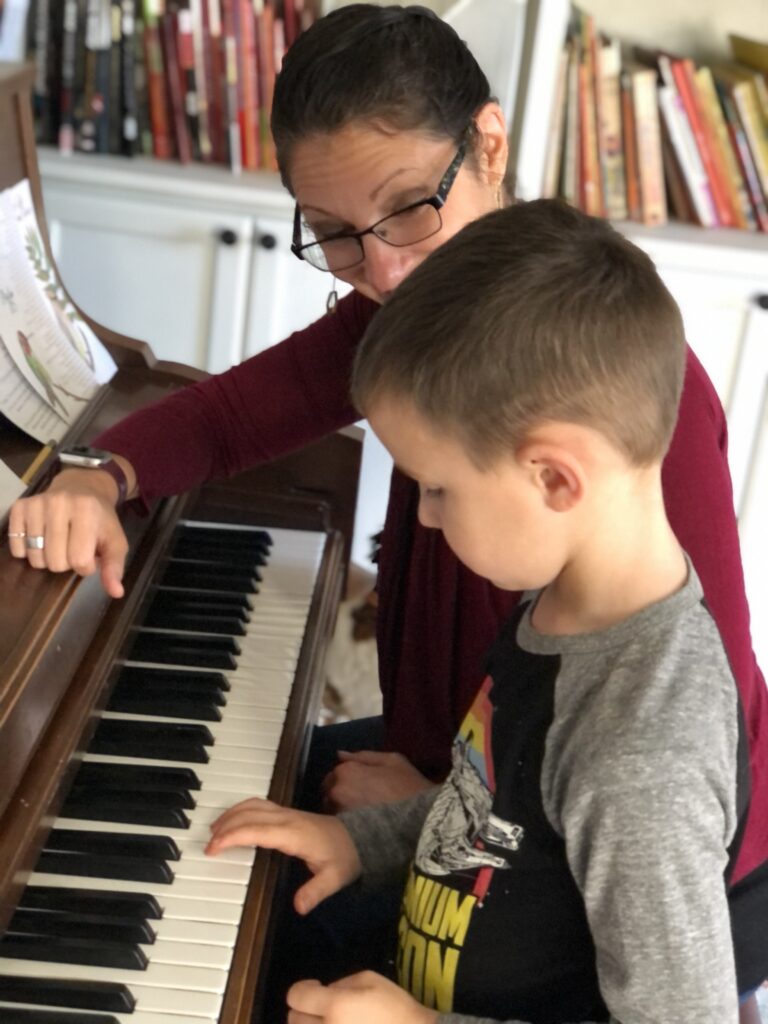
You do not need to be a music therapist—or even musically gifted—to use music intentionally at home. “Music doesn’t have to be good enough to be on an album,” Anna assures us. “Sometimes it’s just humming, or holding a rhythm together. That’s music!”
If you want to go further—like formal music lessons—great! But don’t feel pressure. Musical exposure, especially when fun and low-stress, yields benefits in mood, self-regulation, and family bonding.
The key takeaway from Anna’s work: let music be a tool for connection, not contention. Allow for difference. Value each child’s preference. Let them tell the stories of their favorite songs. Use music to celebrate, transition, and even calm; but most of all, enjoy the process—messy moments and all.
If you’re inspired to try more music in your multi-age household, start with a group playlist. Invite each child to share a favorite, and describe why it’s special to them. You may just find, as Anna has, that music bridges gaps and eases even the most chaotic days.
Let the rhythm of your home serve the unique melody of each child—and, in doing so, bring harmony to your family’s days.

OT is IN #65 Using Music to Support Regulation, Learning, and Connection in Homeschooling and Therapy
We’re welcoming Anna Galloway, an occupational therapist and music therapist whose passion lies in blending the power of music with the practice of OT. With a background that stretches from working in mental health, hospice, and early intervention to championing collaboration across therapies, Anna dives into how music can regulate emotions, support sensory needs, and help families build connection. You’ll hear her expert insights on using music in everyday life, tips for navigating musical interests in large families, and practical advice for parents looking to make meaningful use of music at home. Whether you’re a homeschooling parent, a therapist, or someone just curious about music’s impact on the brain and learning, this episode is filled with actionable ideas and heartfelt stories.
In this episode you’ll hear about:
- Introduction and Background of Anna Galloway
- Anna’s professional journey:
- Started as a music therapist after graduating from the University of Alabama.
- Worked in diverse settings: with refugees’ families, older adults with dementia, inpatient psychiatric programs, hospice, home health, early intervention.
- Discovered occupational therapy (OT) while working in inpatient rehab, returned to school for OT.
- Now a faculty member with a research focus on integrating music and OT.
- Intersection of Music Therapy, Recreation Therapy, and Occupational Therapy
- Discussion of collaborative, creative interdisciplinary teams (e.g., working with recreational therapists).
- Application of prior therapeutic experiences to homeschooling and daily family life.
- Exploring Auditory Processing and Music’s Role
- Transition to a general discussion on music and the brain, separate from specific programs.
- How Music Affects the Brain and Body
- Explanation of how music releases dopamine, serotonin, and oxytocin.
- Roles of these hormones: motivation, mood, attention, social bonding.
- Using music therapeutically:
- For relaxation and coping in hospice/end-of-life care.
- In the NICU to calm infants, regulate physiological responses, promote bonding.
- Broader uses for environmental and emotional support, regulation, and coping.
- Understanding Individual Responses to Music
- Importance of individualized, person-centered music preferences for effective outcomes.
- Dangers of generic, prescriptive music interventions—what’s relaxing to one person might be arousing to another.
- Non-verbal cues in infants and medically fragile populations to gauge music’s effects:
- Watching for facial orientation, hand gestures, crying, physiological signs of overstimulation.
- Adjusting tempo and removing syncopation for NICU use.
- Using music to build tolerance or mask environmental noise as needed.
- Practical Strategies for Using Music with Children and Families
- Adapting music use based on intent (regulation vs. education vs. leisure).
- Tips for group settings or families with mixed music preferences:
- Collaborative playlist-making, ensuring everyone’s input and adequate listening time.
- Observing engagement and adjusting duration to maintain participation.
- Using music for time management and transitions:
- “Three songs” as a non-ambiguous marker for children.
- Opportunities for social sharing and connection during music activities.
- Integrating Music into Occupational Therapy
- Anna’s doctoral research: Training OTs to use music more effectively.
- Barriers OTs may face: comfort with music, creativity, and ambiguity.
- Basic musical elements: rhythm, tempo, use of beats per minute (BPM).
- Using tempo to match and guide activity pace:
Links and Resources From Today’s Show
- Why Should I Seek Occupational Therapy?
- TAP BPM- Online Beats Per Minute Calculator
- Find The BMP And Key For Any Song
- Music As An Occupational Therapy Tool
- Music As Support To Occupational Therapy
- Episode 9: The Impact of Music on Executive Functioning: A Homeschooling Perspective
- Episode 15: From Morning to Night: Incorporating Social Emotional Learning in Homeschool
- Episode 45: Engaging Children Through Project-Based and Interest-Led Homeschooling
- Episode 63: Misophonia Explained: Causes, Triggers, and Real Life Solutions
- Episode 64: Understanding Auditory Processing Disorder: Diagnosis, Treatment, and Support for Families
Connect with our Guest, Anna Galloway
Anna is a Clinical Assistant Professor in Occupational Therapy at the University of Florida. She has been a music therapist for 13 years and occupational therapist for 7 years. Her current research explores uses of music within the occupational therapy scope of practice.