

Homeschooling through Grief
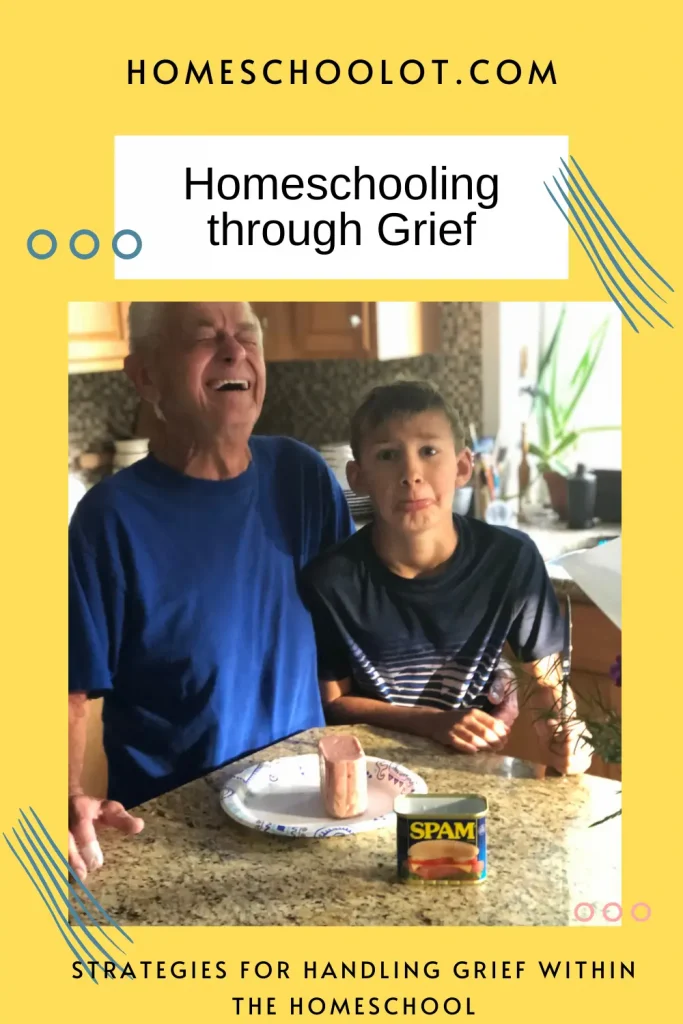
A little over a week ago, we lost my husband’s grandfather. He passed away after a long life and a very short battle with pancreatic cancer. We were fortunate to live his last 7 weeks with him in our home thanks to the pandemic forcing us to quickly move him and his wife of 72 years out of their assisted living.
When they came here, we were worried they were exposed to COVID, that worry quickly passed and then he was diagnosed with cancer. Can you imagine the fear, then love, then happiness, then uncertainty, then joy, then sadness that my children have felt?
As a result, I’ve again been able to draw on my background as an Occupational Therapist and been grateful for our family’s choice to homeschool so that we can teach to the heart during our homeschool day.
The American Occupational Therapy Association provides a list of recommendations for Occupational Therapists to implement when treating those dealing with grief. Those pertaining to homeschooling are
1) Help children get back to regular routines
Routines have an organizing effect and encourage feelings of well being- clearly, some time off is necessary. However, this works well with our overall philosophy of rhythm vs. routine. We can get back to a rhythm in our day ie morning time together, books at lunch, afternoons outdoors very quickly.
2) Encourage participation
in enjoyable but low-stress activities with close friends to minimize feelings of isolation.
3) Provide creative activities
Activites such as art projects and journaling to foster self-expression, which can help with processing difficult feelings. Drawing, painting, craftwork, scrapbooking, making memory boards with photographs, and collages naturally lend to meeting the needs of the grieving child (Milliken, Goodman, & Bazyk, 2007).
My 11 year old made a photo montage of our time during what we lovingly call the “Collins COVID Cancer Chronicles”. We also are spending time reading many picture books to help give a language to grief. Our kids need to know how to talk to express their feelings. Our favorites are The Invisible String, Lifetimes, and Badger’s Parting Gifts.
4) Initiate activities that create memorials
Remembering those who have died to help to preserve what was cherished in the relationship. Baking cookies, wood burning, flower arranging, scrapbooking, drawing, and painting are some of the occupations that we have done this week to help memorialize Pappy and keep our hands busy.
Grief is tough because its different with every person. Utilizing occupations to connect and remember can help. HOmeschool OT is here as a resource for you! Schedule your consultation to advise the homeschool family on how to integrate occupations into the homeschool day.
References
- American Occupational Therapy Association. (2020). Occupational therapy practice framework (4th ed.). American Occupational Therapy https://doi.org/10.5014/ajot.2020.74S2001
- American Occupational Therapy Association. (2012). Grief and Loss. https://www.aota.org/-/media/Corporate/Files/Practice/Children/SchoolMHToolkit/Grief and Loss Final.PDF
- Milliken, B.E., Goodman, G., Basyk, S., Flinn, S. (2007). Establishing a Case for Occupational Therapy in Meeting the Needs of Children with Grief Issues in School-Based Settings. Occupational Therapy in Mental Health, 23 (2).




These are very helpful suggestions.
I would like to remind us all that GRIEF can be caused by a lot of things besides death. Divorce, separation, other ruptured relationships come to mind. Moving (which ruptures proximal relationships, or at the very least, significantly changes them), loss of job . . . . As adults, we often “take it in stride.” We grieve, but we do not grieve openly because it’s “just a part of life.” (Princess Bride, swordfight between Inigo and the Man in Black: “Who are you? “No one of consequence.” “I must know.” “Get used to disappointment.”) As adults, we deal with things and go on, not always realizing the grief (or trauma) that our child is feeling.